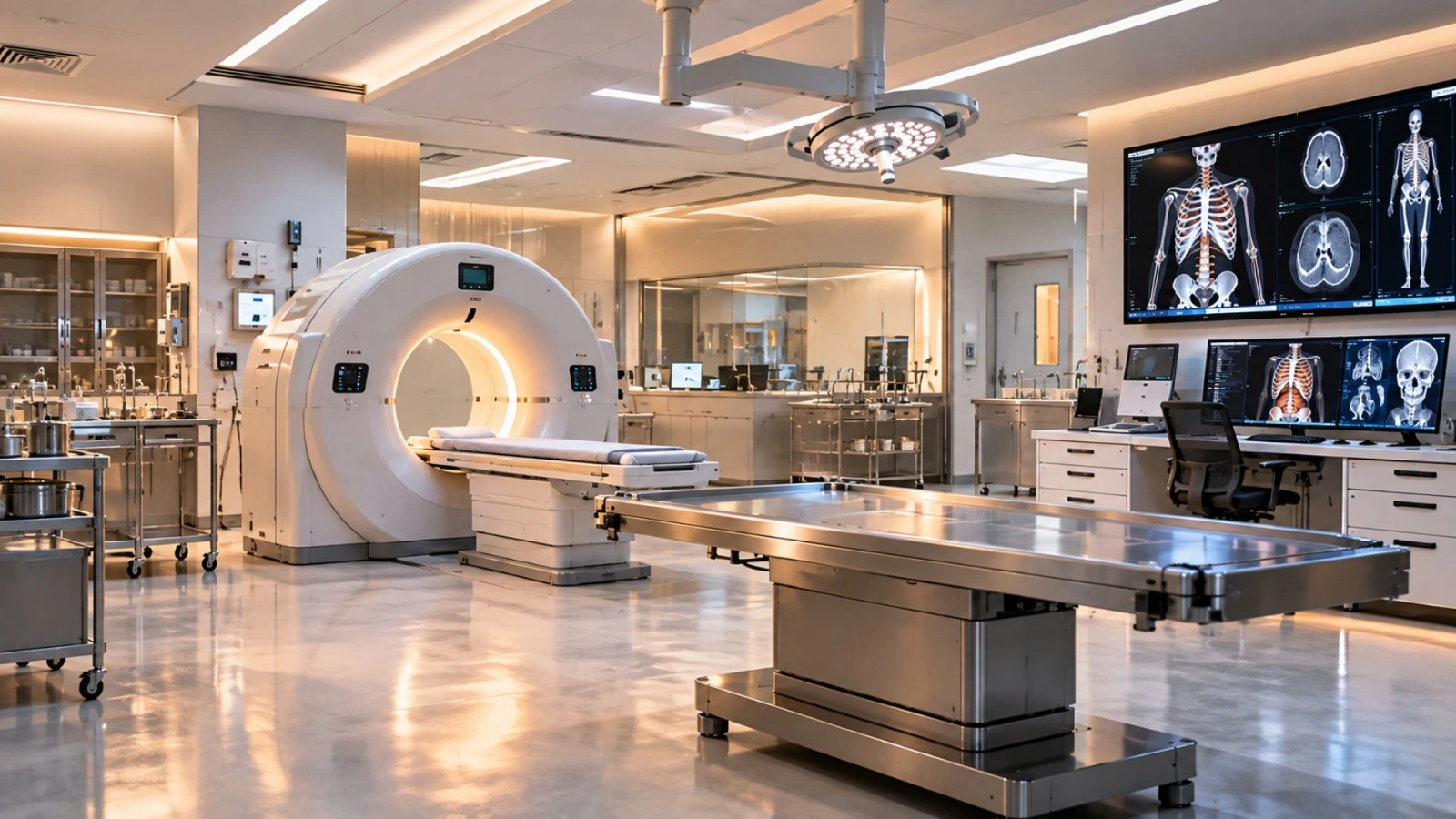
Interest in the virtual autopsy centre is growing as forensic medicine becomes more closely connected with medical imaging, digital evidence and technology. Yet one pattern we often see in conversations with institutions is that planning can begin with the most visible component: the CT scanner. The more important questions come earlier. How will cases move through the facility? Who will interpret the imaging? How will evidence be stored and revisited? How will forensic experts, radiologists, investigators and students interact with the system? This article looks at the decisions that can determine whether a virtual autopsy facility becomes useful infrastructure or simply an advanced imaging installation.
VIRTUAL AUTOPSY FACILITY•28 SEPTEMBER 2026•5 MIN READ
Building a Virtual Autopsy Facility: What Hospitals and Medical Colleges Need to Consider
Summary
A virtual autopsy centre requires much more than imaging equipment. Before deciding how to design the facility, hospitals and medical colleges must consider forensic workflows, infrastructure, digital evidence, specialist expertise, education, and future requirements.
Why the Conversation Needs to Start Before the Scanner Arrives
1. Start With the Forensic Workflow, Not the Equipment List
A postmortem CT scan may take only one part of the overall investigation. Before and after imaging, decisions include case registration, identification, examination, image interpretation, reporting, evidence preservation, and, where required, conventional autopsy or further investigation. This distinction matters when planning infrastructure.
A hospital may primarily need virtual autopsy to strengthen medico-legal investigations. A medical college may also want the facility to support teaching and research. A government institution may need to consider larger caseloads, referrals from multiple locations or disaster-response requirements. Each creates a different workflow.
The INTERPOL Disaster Victim Identification guidance, for example, places post-mortem examination within a much wider process of collecting, comparing and reconciling forensic information. Its guidance on post-mortem procedures specifically recognises CT imaging as useful for documenting injuries, identifying internal features, locating foreign objects and supporting comparison with ante-mortem information.
That provides a useful planning principle: design the case journey first, then place technology within it.
2. The Room Around the CT Scanner Deserves as Much Attention as the Scanner
Infrastructure decisions can become expensive to correct after installation. For institutions in India, CT installations also sit within a defined radiation-safety framework. The Atomic Energy Regulatory Board’s diagnostic radiology guidance covers layout and shielding requirements, sample CT layouts and quality-assurance requirements. AERB guidance also highlights access control, movement through the facility and radiation shielding as considerations in CT room planning.
For a virtual autopsy facility, however, spatial planning has another dimension. Movement involves the deceased rather than conventional patient flow. Institutions therefore need to think through practical questions such as:
- How will the deceased enter and leave the imaging area?
- Can trolleys and body-handling equipment move without unnecessary transfers?
- Is the scanning area appropriately connected with the mortuary and examination areas?
- Where will forensic specialists review images and discuss findings?
- Can access to sensitive cases and records be controlled?
- Has sufficient space been considered for future equipment or workflow changes?
These details may seem operational during planning. Once the centre begins handling cases, they influence almost every working day.
3. A Postmortem CT scan Produces Evidence, Not Just Images
One of the biggest shifts introduced by virtual autopsy is that part of the post-mortem examination becomes a digital record. That changes the infrastructure requirement considerably.
A postmortem CT scan can generate a dataset that may need to be reviewed by different specialists, correlated with other findings, used for teaching where legally and ethically appropriate, or revisited later in an investigation. INTERPOL’s post-mortem DVI guidance recommends systematic imaging and secure preservation of post-mortem records.
This means storage capacity alone is not enough. A virtual autopsy centre needs to consider:
- structured case identification and retrieval
- controlled user access
- image and report storage
- backup and preservation
- traceability of records
- integration with reporting and evidence workflows
We explored this issue in greater depth in our article, Digital Autopsy Records: Why Long-Term Preservation Matters in Forensic Investigations.
A useful question during planning is therefore not simply, “Where will we store the scans?” It is, “How should this evidence remain usable five or ten years from now?”
4. Who Will Read the Images, and Who Will Own the Finding?
Technology does not remove the need for forensic judgement. It makes collaboration more important. Research on post-mortem imaging also supports a measured approach. A systematic review and meta-analysis covering 66 studies and 4,213 individuals found that different post-mortem imaging modalities perform differently across types of findings. The authors argued for the reasoned use of each modality rather than treating imaging as universally interchangeable with autopsy. In practice, that makes expertise part of facility design.
Institutions may need protocols covering the roles of forensic medicine specialists, radiologists, radiographers or CT technologists, mortuary personnel and investigators. They also need clarity on when imaging is sufficient for a particular purpose, when additional examination is indicated, and how different findings are integrated into the final forensic opinion.
Our earlier article, Virtual Autopsy vs Conventional Autopsy: Understanding Their Complementary Roles, discusses this relationship in more detail.
A sophisticated scanner without an equally mature interpretation workflow leaves an important part of the investment unfinished.
5. Medical Colleges Have an Additional Opportunity: Make the Centre a Learning Environment
For medical colleges, a virtual autopsy facility can offer value beyond individual cases.
When appropriately governed, digital forensic imaging creates opportunities for students and professionals to study anatomy, trauma patterns and pathological findings using cases that can be reviewed repeatedly. The same infrastructure can support multidisciplinary discussion, research and continuing professional development. This is where facility planning begins to influence the future workforce.
A teaching institution might therefore consider whether its virtual autopsy centre should include:
- dedicated image-review and teaching capability
- interactive visualisation for classroom discussion
- structured access to anonymised teaching cases
- facilities for multidisciplinary case review
- research-ready data governance
- training for forensic professionals in interpreting digital imaging
We have discussed this wider opportunity in Why Medical Colleges Should Teach Virtual Autopsy Today.
The centre can then become part of the institution’s academic infrastructure rather than functioning only when a case arrives.
6. Plan for the Cases You May Need to Handle Tomorrow
One planning exercise we find particularly useful is to ask institutions to imagine the facility several years after commissioning. Case volumes may increase, new imaging techniques may become relevant, and digital archives will grow. More departments may want controlled access to information. Teaching and research requirements may expand. A centre may even need to contribute to a coordinated response during a mass-fatality incident.
INTERPOL’s DVI framework demonstrates why forensic systems need to support coordinated work between multiple specialist disciplines when incidents involve many victims.
This does not mean every institution needs to build for every possible scenario. It means the initial architecture should avoid making reasonable future expansion unnecessarily difficult.
That can affect decisions about storage, network capacity, reporting systems, room layouts, workstation provision, training and integration with other forensic infrastructure.
7. The Most Useful Planning Question Is: What Should This Centre Enable?
At SEVA Technologies, our view of virtual autopsy has developed through conversations around forensic infrastructure, imaging, education and digital workflows. Those conversations have reinforced one idea: institutions get more value when the centre is considered as an ecosystem from the beginning. The technology should support the forensic expert. The digital workflow should protect the integrity and accessibility of evidence. The infrastructure should respect the dignity of the deceased. And where the centre belongs to a teaching institution, it should help strengthen the knowledge of the professionals who will practise forensic medicine in the years ahead.
This philosophy shapes how we approach virtual autopsy infrastructure, including imaging, interactive visualisation, forensic recording, evidence management, training and institutional workflows.
Readers interested in seeing how these elements come together can also explore Inside a Modern Virtual Autopsy Centre: What Does It Actually Look Like?
Conclusion: A Virtual Autopsy Centre Is Infrastructure for the Future of Forensic Care
Building a virtual autopsy centre requires decisions about workflow, people, physical infrastructure, digital evidence, education and future expansion alongside imaging technology. Institutions that consider these elements together are better placed to create facilities that support forensic practice today while improving enterprise readiness for changing investigative, academic and infrastructure requirements.
Planning a virtual autopsy facility?
Explore SEVA Technologies’ approach to integrated Virtual Autopsy solutions and forensic infrastructure, or request a discussion with our team to understand the considerations relevant to your institution.
FAQs
A virtual autopsy centre typically requires suitable CT imaging infrastructure, radiation-safe facility design, post-mortem handling workflows, image-review capability, digital storage, reporting systems and trained personnel. In India, institutions should also consider applicable AERB requirements for CT installations. The exact configuration should reflect expected caseloads, medico-legal responsibilities, teaching requirements and the institution’s existing forensic infrastructure.
No. The scanner is central to postmortem CT imaging, but the facility's effectiveness depends on the workflow around it. Institutions also need to consider body movement, image interpretation, forensic reporting, evidence preservation, access control, specialist collaboration and training. Planning these elements together helps turn imaging equipment into a functional forensic service.
A postmortem CT scan creates cross-sectional images of the deceased that forensic specialists can examine for findings such as skeletal injuries, foreign objects, gas distribution and certain internal abnormalities. Depending on the case, PMCT may complement conventional autopsy or contribute to other post-mortem investigations. Qualified forensic professionals should determine its role based on the circumstances of each case.
Virtual autopsy and conventional autopsy have different strengths. Evidence shows that post-mortem imaging can be particularly useful for certain findings, while other conditions may require additional examination or a conventional autopsy. The appropriate approach therefore depends on the case, investigative requirements and expert judgement rather than treating one method as a universal replacement for the other.
Planning should consider more than the immediate size of CT datasets. Institutions need to account for increasing case volumes, retention requirements, backups, controlled access, retrieval, linkage between images and reports, and the possibility that records may need to be revisited years later. Storage planning should therefore form part of the forensic evidence strategy from the beginning.
A virtual autopsy facility can support forensic investigation while also creating opportunities for education and research. Digital cases can, subject to appropriate governance and anonymisation, support repeated review, multidisciplinary teaching and study of anatomy, injury patterns and post-mortem findings. This can help medical colleges introduce future forensic professionals to imaging-led methods as part of their training.
Begin with the institution’s intended use, expected caseload, forensic workflow, available expertise, infrastructure and future plans. Then evaluate how imaging, visualisation, reporting, evidence storage and training will work together. Technology selection becomes more meaningful once these requirements are clear, because the institution is evaluating what the centre needs to accomplish rather than comparing equipment specifications in isolation.